You built the website. You shared it on social media. Maybe you even paid for Google Ads.
But the phone isn’t ringing. The enquiry form is empty. And you’re watching competitors pull in customers while your site just sits there — looking pretty, doing nothing.
If that sounds familiar, you’re not alone. Thousands of UK small business owners are in the exact same position. And the frustrating part? The problem usually isn’t your product or your prices. It’s your website.
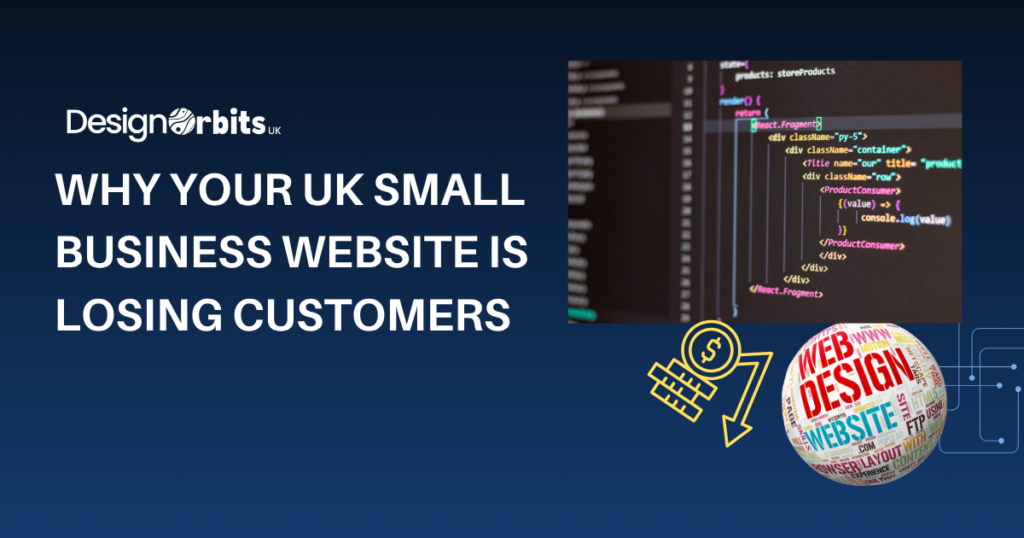
Here’s why your UK small business website is losing customers
Here’s the thing nobody tells you upfront: having a website and having a website that works are two completely different things. Most small business sites fall into a handful of the same traps. Let’s go through them — and be real about what’s actually going wrong.
1. It Takes Too Long to Load — and People Leave Instantly
📊 53% of mobile visitors abandon a page that takes longer than 3 seconds to load.
Source: Google / Think with Google — Mobile Site Load Time Statistics
Three seconds. That’s roughly how long someone will wait for your page before clicking away. Not five, not ten. Three. And on a mobile connection — which is how most people in the UK browse these days — that window can feel even shorter.
Older websites built on heavy themes, with uncompressed images and a pile of plugins running in the background, are the usual culprits. You might not even notice the slowness on your own laptop. Your customers do.
Quick check: Google ‘PageSpeed Insights,’ drop your URL in, and see what comes back. Anything under 70 on mobile deserves attention — and probably sooner rather than later.
2. The Design Doesn’t Make People Feel Safe Spending Money
📊 As page load time increases from 1 second to 5 seconds, the probability of a bounce jumps by 90%.
Source: Google Benchmarking Data — Envisage Digital UK
This sounds a bit harsh, but it’s worth saying plainly: if your website looks like it was thrown together, visitors assume your business was too. People can’t see your workshop, meet you in person, or feel the quality of your work through a screen. Your design does all of that for them — in about four seconds flat.
It’s not about flashy animations or spending a fortune. It’s about consistency, professionalism, and trust signals. Things like:
- Genuine photos of your team or your work — not generic stock imagery
- Customer reviews are actually visible on the page, not buried in a footer link
- A logo that looks like it belongs to a real business
- Colours and fonts that don’t clash or change randomly between pages
Small things, but they add up fast in the mind of someone deciding whether to get in touch or move on.
3. Nobody Can Tell What You Actually Do
Go to your own homepage right now. Without scrolling, without reading every line — could a total stranger figure out what you do, who it’s for, and why they should pick you? In five seconds?
Most can’t pass this test. The homepage says something like ‘Delivering excellence since 2008’ or ‘Your trusted local partner.’ Lovely. But what do you actually do?
People are impatient online. They’re not going to poke around trying to work you out. Your headline needs to answer three questions immediately:
- What do you offer?
- Who is it for?
- What happens when someone contacts you?
Clear beats clever. Every single time.
4. There’s No Obvious Next Step Anywhere
📊 70% of small business websites have no clear Call to Action on their homepage.
Source: Marketing LTB — Small Business Website Statistics
You’d be surprised how many business websites — built and paid for — have no clear way to get in touch without digging. The phone number is tiny in the corner. The contact page is buried three clicks deep. There’s no button that says ‘Get a Quote’ or ‘Book a Call’ anywhere near the top of the page.
People don’t scroll to hunt for how to hire you. They just don’t. If the next step isn’t obvious, they’ll find someone whose website makes it obvious.
Every key page — homepage, services, about — should have one clear call to action, placed where people can actually see it. Not subtle. Not tasteful. Visible.
5. It Falls Apart on Mobile
📊 70% of small business websites have no clear Call to Action on their homepage.
Source: Marketing LTB — Small Business Website Statistics
Over 60% of UK web traffic is now on smartphones. That number isn’t going down. And yet, loads of small business websites still have text that’s too small to read, buttons that sit too close together, and layouts that go a bit wobbly on anything smaller than a laptop screen.
Google also uses mobile performance as a ranking factor. So if your site isn’t properly optimised for mobile, you’re invisible in search results and unusable for the majority of visitors. That’s a double hit you don’t want.
Grab your phone. Open your own site. See what your customers actually see.
6. Google Has No Idea You Exist
A well-designed website that nobody can find is basically a very expensive brochure locked in a drawer. SEO doesn’t have to be complicated at the small business level, but it does have to exist.
Many UK small business sites have no page titles set up properly, no meta descriptions, no local keywords, no Google Business Profile linked up — nothing that tells Google what the site is about or where it’s based. So when someone in your town searches for exactly what you offer, you don’t appear.
Start with the basics. Make sure each page has a proper title and description. Use the words your actual customers type — not industry jargon. And if you haven’t set up a Google Business Profile yet, do that today. It’s free and it matters more than most people realise.
7. Your Website and Your Brand Don’t Match
📊 Small businesses with websites grow roughly 2× faster than those without — yet many UK sites are still underperforming.
Source: Marketing LTB — Small Business Website Statistics
Imagine walking into a shop where the sign outside, the packaging inside, and the staff uniforms all look like they’re from different businesses. You’d feel a bit uneasy, right? That’s exactly how customers feel when your website doesn’t match the rest of your brand.
It’s not just aesthetics. Inconsistency signals to people — at a subconscious level — that your business might not have its act together. A consistent brand identity across your website, your social media, and your printed materials builds the kind of quiet confidence that converts browsers into buyers.
So Where Does That Leave You?
None of these issues are fatal. That’s the good news. But they’re also not going to fix themselves — and every week your website isn’t working properly is a week of potential customers ending up somewhere else.
Your website should be pulling its weight. Generating enquiries, building trust, working in the background while you get on with actually running the business. If it isn’t doing that, something needs to change.
Small business website not getting enquiries? Website not converting visitors UK?why is my website not getting leads? improve small business website UK? |
If these are your queries and you are Ready to Fix It? Let’s Talk.
At DesignOrbits, we work with UK small businesses to build websites and brand identities that actually do something. Not just look good — but bring in leads, build credibility, and hold up under scrutiny.
If you’re not sure what’s holding your website back, we’ll tell you — no fluff, no jargon, just straight answers.
Get in touch today: Design Orbits
You might also find these useful:
• How Much Does a Logo Cost in the UK in 2026?
• Design Agency vs Freelancer — Which Is Right for You?
• What Is a Subscription Design Agency?
• Our Logo Design Process Explained
STATS SOURCES USED IN THIS ARTICLE
[1] Google / Think with Google — Mobile Site Load Time Statistics
[2] Envisage Digital UK — Website Load Time Statistics
[3] Stanford University Web Credibility Research (via Paradigm Marketing)
[4] British Researchers / Forbes — 94% Design First Impressions